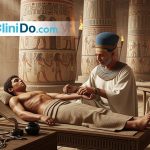
Imhotep built the first pyramid in ancient Egypt, the Step Pyramid of Djoser at Saqqara, a monumental leap in ancient Egyptian architecture.
Surprisingly, Imhotep was not only the first architect to design pyramids, but he also possessed profound knowledge of medicine in ancient Egypt.
He is considered the first physician in human history, and he founded a medical school in Memphis, which later became a center for his worship.
Imhotep was also well-versed in the arts of mummification and anatomy, and he authored many papyrus scrolls on the treatment of diseases, in addition to his knowledge of astronomy.
In this article, we will take you on a journey through the medical sciences in Egypt, from the dawn of the Pharaonic civilization to the present day.
Highlighting how Egypt has always stood out for its exceptionally skilled doctors across various specialties.
The most famous papyrus on the practice of medicine in ancient Egypt
Papyrus scrolls documents written on sheets made from the papyrus plant were a rich source of knowledge about many aspects of ancient Egyptian civilization.
In Pharaonic Egypt, papyri were used in advanced school and temple education and for recording important documents, since the ink used on them was difficult to erase.
Among these, the Ebers Papyrus stands out as the oldest preserved scientific manuscript produced by ancient Egyptian civilization.
It serves as an essential reference for internal medicine, ophthalmology, dermatology, limb diseases, gynecology, and even some surgical practices.
This papyrus contains over 700 magical formulas and medical prescriptions for treating various illnesses.
It also includes terminology related to anatomy, physiology, and treatment methods.
It is believed to have been written around 1500 BCE, though some sections may date back as early as 3400 BCE.
The Ebers Papyrus is also one of the oldest known medical documents, providing evidence of sound scientific procedures.
It suggests that Egyptian physicians had a solid understanding of the structure of bones and the functions of the brain and liver.
Fields of Medicine in Ancient Egypt
According to the Ebers Papyrus, numerous branches of medicine were described in detail — including the functions of body organs and various health treatments.
The Heart
The ancient Egyptians believed that the heart was the center of blood supply in the body, and the point where all vessels met, carrying tears, urine, semen, and blood.
Mental Illness
Modern researchers in 2014 described the Egyptians’ understanding of the cardiovascular system as “remarkably advanced, though not entirely accurate.”
The papyrus also discussed the characteristics, causes, and treatments of mental disorders, such as dementia and depression.
Surgery
The Egyptians believed that mental illnesses were caused by evil spirits or the wrath of the gods.
Egyptian physicians practiced suturing wounds and used certain plants, such as willow leaves, as antiseptics. They also used basic surgical tools like forceps and clamps.
Dentistry
The ancient Egyptians also practiced dentistry, as tooth decay was quite common at the time.
They used remedies made from cumin, incense, and onions to treat gum swelling, and opium for pain relief.
In some cases, they drilled holes in the jaw to drain abscesses, though there is little evidence that they extracted teeth.
Family Planning
The manuscript included information about contraceptive methods, ways to detect pregnancy, and other gynecological issues.
General Health Advice
The papyrus provided health guidelines for treating skin problems, dental diseases, eye disorders, intestinal issues, parasites, tumors, burns, abscesses, and fractures.
Additionally, physicians offered preventive health advice to the general public, encouraging them to wash and shave their bodies to prevent infections, eat carefully, and avoid unclean animals and raw fish.
The Most Famous Practitioners of Medicine in Ancient Egypt
Imhotep and Amenhotep, son of Hapu, are among the most renowned physicians of ancient Egypt.
Imhotep’s fame as one of the greatest doctors in history endured through the ages.
Numerous statues and inscriptions have been found in his honor, reflecting the deep respect and high status he held.
The ancient Egyptians also developed medical specialization, with distinct physicians for surgery, ophthalmology, gynecology, and dentistry.
They established strict criteria for admission into medical schools — a physician had to be:
1- Quiet and thoughtful
2- Wise
3- Compassionate
4- Honest
The Egyptians also founded hospitals to treat patients and dispense medicines, demonstrating an organized healthcare system.
Moreover, they mastered the art of mummification, one of the most striking achievements of ancient Egyptian civilization.
This practice served as strong evidence of their advanced understanding of anatomy and medicine in ancient Egypt.
?What Substances Were Used in Ancient Treatments
The Ebers Papyrus mentions a wide range of remedies derived from medicinal herbs, natural plants, and animal substances used to treat ailments such as headaches, wounds, burns, and skin diseases, among others.
Some of these ancient treatments included:
1- Asthma: honey, milk, sesame, and frankincense.
2- Burns and skin diseases: aloe vera.
3- Pain relief: thyme.
4- Digestive problems: mint, garlic, sandalwood, and juniper.
5- Bad breath: mint and caraway.
6- Epilepsy: camphor.
7- Vomiting: mint to stop it, and mustard seeds to soothe it.
These natural ingredients highlight the advanced use of herbal medicine in ancient Egypt — a foundation for many modern therapeutic practices.
The Evolution of Medicine in Egypt: From Past to Present
Just as ancient Egypt was the cradle of medicine, modern Egypt has become home to generations of physicians who have carried the torch of excellence, passing it from papyrus scrolls to modern technology.
The practice of medicine, which began in ancient Egypt, continued to evolve through the ages from the Pharaonic era to the Greek and Roman periods, when Alexandria gained worldwide fame as a beacon of science and knowledge.
Medicine in Egypt also flourished during the Islamic era, marked by the establishment of major hospitals (Bimaristans) dedicated to treating patients and teaching medicine.
In the modern era, Mohamed Ali Pasha played a pivotal role in advancing medical education by founding medical schools.
Eventually, this led to the establishment of Qasr Al-Ainy Hospital in the 19th century, a cornerstone of modern Egyptian medicine.
The excellence of Egyptian physicians today is no coincidence. Throughout history, Egypt has continually produced exceptional medical professionals.
And to this day, it remains a regional and international destination for medical treatment, led by the skilled descendants of Imhotep.
The Most Famous Egyptian Doctors in the Modern Era
The enduring reputation of Egyptian physicians throughout history is no coincidence.
But it is the result of centuries of accumulated knowledge, skill, and education in Egypt’s most prestigious medical schools.
Egypt has produced some of the world’s most distinguished doctors, many of whom have earned international recognition and honors, including:
1- Sir Magdi Yacoub – A world-renowned Egyptian heart surgeon and one of the pioneers of modern cardiac surgery.
2- Dr. Mohamed El-Zawahry – The discoverer of a psoriasis treatment.
3- Doctor Hossam Mowafi – One of the most respected internal medicine specialists in Egypt and the Arab world.
4- Dr. Mohamed Ghoneim – A pioneer in kidney transplantation in Egypt and the Middle East.
5- Dr. Hany Abdel-Gawad – Awarded Best Doctor in the World, and a leading spine surgery specialist.
These figures embody the legacy of excellence that began with Imhotep, continuing Egypt’s rich medical heritage into the modern age.
Medical Tourism in Egypt: A Global Destination
The excellence of Egyptian physicians has long transcended national borders.
Today, Egypt once again stands as a global hub for medical tourism, drawing upon its ancient legacy and the expertise of its modern doctors.
In Egypt, patients find a unique combination of deep medical knowledge, particularly in surgery and cosmetic medicine.
Along with globally competitive prices, warm hospitality, and world-famous tourist attractions.
Together, these make Egypt an unmatched destination for healing and recovery.
At the heart of this renaissance is CliniDo, your trusted partner in medical tourism in Egypt, serving as a bridge between world-class Egyptian healthcare and patients from across the globe.
CliniDo offers a seamless, end-to-end healthcare journey from connecting patients with Egypt’s top medical specialists.
It arranges surgical appointments and comfortable accommodations near leading hospitals.
To ensure comprehensive follow-up care after patients return home.
Through this holistic approach, CliniDo revives Egypt’s historic role as a safe and trusted medical haven, continuing thousands of years of excellence in healthcare and healing.
The world’s attention now turns toward the grand opening of the Grand Egyptian Museum (GEM),
A monumental landmark that not only showcases Egypt’s golden treasures but also its medical and scientific heritage.
Also, the museum features ancient surgical instruments and medical papyri.
It is tangible proof of how far the ancient Egyptians had advanced in understanding the human body and the science of medicine.
Conclusion
In conclusion, medicine in Egypt, both ancient and modern, remains a beacon for the world.
Egypt continues to produce some of the most skilled and respected doctors globally, and is home to the largest and most reputable internationally accredited hospitals in the Arab world.
From the art of mummification to the precision of modern endoscopic and laser surgeries, the Egyptian physician remains a symbol of medical mastery and human compassion.
Clinido proudly offers you a comprehensive, world-class medical experience in Egypt.
It provides a wide range of high-quality, affordable treatments with Egypt’s best doctors and specialists.